
“Thou wilt shew me the path of life: in thy presence is fulness of joy; at thy right hand there are pleasures for evermore.” — Psalm 16:11
A Road Through the Tombs
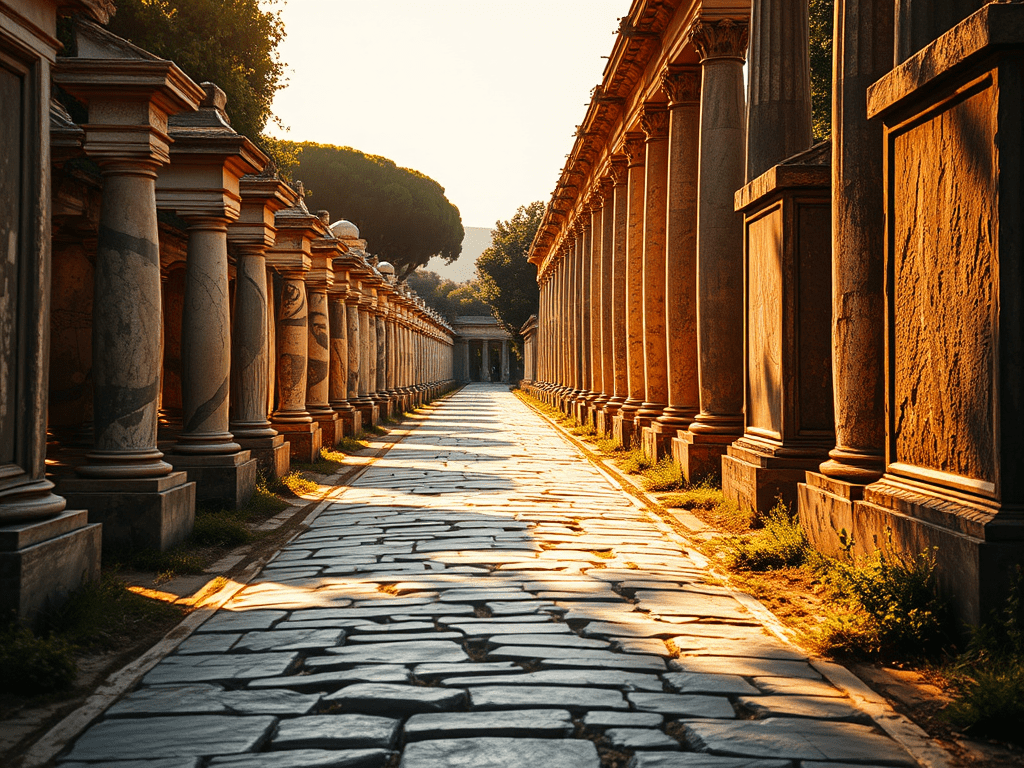
In 312 BC, the Roman censor Appius Claudius Caecus began construction on the first great highway of the ancient world. The Via Appia stretched from Rome to Brindisi, and for six centuries it served as the lifeline of an empire. Soldiers, merchants, and diplomats all traveled it. But here is the detail that matters for us this week: Roman law required that the dead be buried outside city walls, and the most prestigious burial sites sat along the major roads. So the Via Appia became, among other things, a corridor of tombs. Senators, generals, freedmen, and emperors lined the roadside in marble monuments, one after another, mile after mile.
To walk toward Rome was to walk through a cemetery.
The Apostle Paul made this walk. Acts 28 tells us that Paul traveled the Appian Way into Rome, and that believers came out to meet him along the road at the Forum of Appius and Three Taverns. Picture it: a man who had staked his entire life on the resurrection of Jesus, walking past hundreds of monuments to the dead, carrying a message that death had been defeated. The road to Rome’s living heart passed through its graveyard. And Paul walked it proclaiming that the path of life runs the same direction.
That image holds the Scripture readings together this week. Each text asks the same question from a different vantage point: What does the path of life look like when it begins at an empty tomb?
Psalm 16: A Hope That Outgrows Its Author
David wrote Psalm 16 as a song of trust. He had placed his whole life in God’s hands, and he could say with confidence: “The LORD is the portion of mine inheritance and of my cup” (v. 5). Everything he needed, everything he hoped for, was anchored in the faithfulness of God. So far, so good. Any Israelite could sing this psalm and mean every word of it.
But then David says something that goes further than his own story can carry: “For thou wilt not leave my soul in hell; neither wilt thou suffer thine Holy One to see corruption” (v. 10). And then: “Thou wilt shew me the path of life” (v. 11). David was writing about trust in God’s faithfulness beyond the grave, but David himself died, was buried, and his body returned to dust. The psalm reaches toward a fulfillment that David could express but could only see from a distance. It is a promise shaped like a doorway, waiting for someone to walk through it.
John 20:19–31: The Doorway Opens
Someone did. On the evening of the first Easter, Jesus stood among his terrified disciples in a locked room and said, “Peace be unto you” (v. 19). Then he showed them his hands and his side. The body that had been crucified, dead, and buried was standing in front of them, breathing, speaking, and whole. And the next thing Jesus did was breathe on them and say, “Receive ye the Holy Ghost” (v. 22). He commissioned them: “As my Father hath sent me, even so send I you” (v. 21).
This is where the path of life becomes visible. Jesus walked through death and out the other side, and the first thing he did with his risen life was send his followers out on the same road.
Thomas, of course, was absent. And when his friends told him what had happened, Thomas demanded proof: hands, nails, side. Eight days later, Jesus returned and offered exactly what Thomas asked for. Thomas responded with the highest christological confession in John’s Gospel: “My Lord and my God” (v. 28). Jesus accepted the confession and then extended the blessing outward across time: “Blessed are they that have not seen, and yet have believed” (v. 29). The path of life now stretches beyond that room in Jerusalem into every generation that follows.
Acts 2:14a, 22–32: Peter Names the Pattern
Fifty days later, Peter stood in front of a crowd at Pentecost and did something remarkable: he went back to Psalm 16 and read it out loud. He quoted David’s words about the Holy One and the path of life, and then he made his argument. David “is both dead and buried, and his sepulchre is with us unto this day” (v. 29). David wrote these words, but they were about someone else. David was a prophet who “seeing this before spake of the resurrection of Christ, that his soul was not left in hell, neither his flesh did see corruption” (v. 31).
Peter’s sermon is the hermeneutical key to the whole set of readings. He takes the Old Testament hope and shows that it has been fulfilled in the resurrection of Jesus. The psalm’s promise outgrew David because it was always aimed at Christ. And Peter can stand in front of that crowd and say, “This Jesus hath God raised up, whereof we all are witnesses” (v. 32). The path of life that David sang about has been opened by the risen Christ, and Peter is walking on it.
1 Peter 1:3–9: Walking the Road
By the time we reach the epistle, the path of life has extended across geography and years. Peter writes to scattered believers throughout Asia Minor, people who have been “begotten again unto a lively hope by the resurrection of Jesus Christ from the dead” (v. 3). They possess “an inheritance incorruptible, and undefiled, and that fadeth not away, reserved in heaven” (v. 4). David sang about pleasant places and a goodly heritage; the church has received an inheritance that outlasts the world.
But here is the pastoral honesty that makes 1 Peter so valuable: the path of life includes “heaviness through manifold temptations” (v. 6). The readers are suffering. Their faith is being tested “with fire” (v. 7). And yet they rejoice. Why? Because they love and believe in someone they have yet to see face to face (v. 8). This connects directly back to Jesus’ blessing in John 20:29: “Blessed are they that have not seen, and yet have believed.” The scattered church is living inside that beatitude. They walk the path of life by faith rather than by sight, and they receive “the end of your faith, even the salvation of your souls” (v. 9).
So Where Does the Path Lead?
The four readings trace a single trajectory. David sang about a path of life that God would reveal to him (Psalm 16). Jesus opened that path by rising from the dead and commissioning his followers to walk it (John 20). Peter named the connection between David’s hope and Christ’s resurrection, and called the watching crowd to recognize what God had done (Acts 2). And the epistle shows us the church already on the road, walking through fire, clinging to a living hope, and receiving the salvation that David could only glimpse from a distance (1 Peter 1).
The practical question for us is the same one these texts keep asking: Will you walk the path?
The risen Jesus breathed on his disciples and sent them out. He did the same for Thomas after eight days of doubt. Peter carried that commission all the way to Pentecost, where he told a crowd exactly what God had done. And scattered believers across Asia Minor discovered that the path of life was sturdy enough to hold them through suffering, exile, and uncertainty.
The path of life starts at the empty tomb and moves outward into the world. It moves through your workplace, your neighborhood, your family, and your church. It runs through seasons of doubt (ask Thomas) and seasons of testing (ask the readers of 1 Peter). The risen Christ has already walked the hardest part of the road, and he sends you down it with the same words he spoke to his first followers: “Peace be unto you. As my Father hath sent me, even so send I you.”
Walk the road this week. Carry the resurrection with you.
Points to Ponder
- David wrote about a hope that exceeded his own experience. Where in your life has God given you a promise that you can see but have yet to fully receive? How do you hold onto that kind of hope?
- Jesus returned specifically for Thomas. He met Thomas exactly where the doubt was and offered exactly the evidence Thomas had demanded. What does this tell you about how Christ responds to honest struggle?
- Peter’s sermon at Pentecost required him to stand in front of people who had participated in the crucifixion and tell them the truth about what God had done. Where in your life is God asking you to speak about the resurrection in an uncomfortable setting?
- The believers in 1 Peter were suffering and yet rejoicing. They loved someone they had yet to see. How does their example reshape the way you think about faithfulness during a difficult season?
- Each of these texts involves a form of sending or witness. David testified in song. Jesus commissioned the disciples. Peter preached to a crowd. The epistle circulated to scattered churches. What form does your witness take this week?
A Prayer for the Week
Father, you showed David a path of life that he could sing about but could only glimpse from a distance. You fulfilled that promise when you raised Jesus from the dead, and you continue to fulfill it as your church walks the road of faith through every generation.
Meet us where we are this week. Meet us in our locked rooms of fear, as you met the disciples. Meet us in our stubborn doubts, as you met Thomas. Give us the courage of Peter, who stood up and told the truth about the resurrection to a crowd that needed to hear it. And give us the endurance of those early believers who loved you without seeing you, who trusted your promises through fire and trial.
Send us out. As you sent your Son, and as your Son sent his disciples, send us into our workplaces, our families, our churches, and our communities with the peace and commission of the risen Christ. Keep us on the path of life, and bring us at last to the fullness of joy in your presence.
Through Jesus Christ our Lord, who lives and reigns with you and the Holy Spirit, one God, now and forever. Amen.
“This Jesus hath God raised up, whereof we all are witnesses.” — Acts 2:32
 Josh Cehulik