
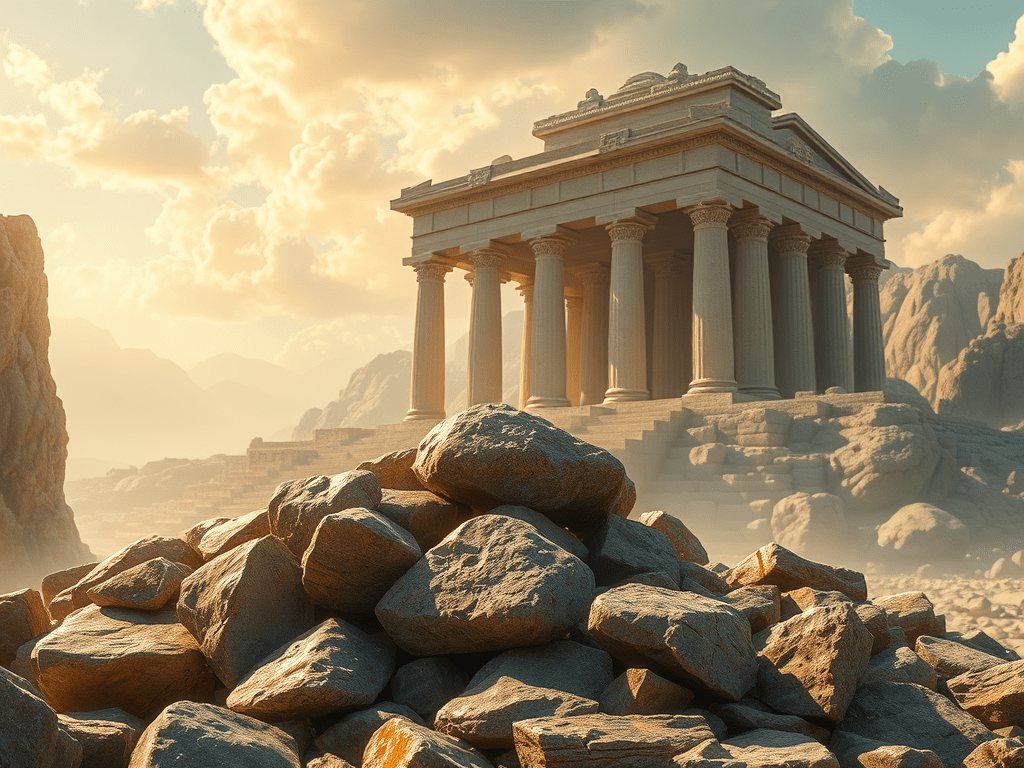
“The stone which the builders refused is become the head stone of the corner. This is the LORD’s doing; it is marvellous in our eyes.” — Psalm 118:22–23
The Reject Pile
Archaeologists working near the Temple Mount in Jerusalem have uncovered ancient quarries where Herod’s masons cut and shaped limestone blocks for the temple complex. Among the rubble at these sites, they found stones still bearing chisel marks where workers tested them and set them aside. The process was straightforward: a mason would strike a stone, examine its grain, and check for hidden fractures. Stones that failed went to the reject pile.
Here is the detail worth noticing. A cornerstone had to do something that ordinary wall stones could not. It had to anchor two walls at their junction, bearing load from two directions at once. It required an unusual shape and a particular kind of density. A stone passed over for standard wall work might turn out to be the exact piece needed for the most structurally important position in the building.
The psalmist knew this image well. And centuries later, so did the crowd on the road to Jerusalem.
A Song for the Road (Psalm 118:1–2, 19–29)
Psalm 118 is a processional hymn. The worshiper approaches the temple gates, asks for entry, and gives thanks for God’s deliverance. At its center stands the image of the rejected cornerstone (v. 22), and from there the congregation lifts its cry: Hoshia na, “Save us, we pray” (v. 25). Then comes the blessing pronounced over the one who enters in the name of the LORD (v. 26), and the procession moves toward the altar and the sacrifice (v. 27).
Follow the movement of the psalm: gates, to cornerstone, to a cry for salvation, to a blessing, to the altar. The worshiper walks toward the place of sacrifice while recognizing along the way that God builds his purposes through the very things others discard. Israel knew this pattern from its own story. The youngest son David became king. The enslaved nation became God’s covenant people. The pattern of God’s redemptive work runs consistently through rejection toward exaltation, through the discard pile toward the place of honor.
A King on a Donkey (Matthew 21:1–11)
Matthew places Jesus on this same road, moving toward these same gates. The crowd reaches for the words of Psalm 118:25–26, shouting “Hosanna” and “Blessed is he that cometh in the name of the LORD.” They spread branches and garments on the road, receiving Jesus as Israel’s king. Yet Matthew wants us to see what the crowd grasps only in part. Jesus rides a donkey, fulfilling Zechariah 9:9: a king defined by meekness. And he rides toward the very week in which he will become the rejected stone of Psalm 118:22. Within days, the city shouting “Hosanna” will shout “Crucify him.” The stone that the builders of Israel’s religious establishment will refuse is on its way to becoming the cornerstone of everything God is building.
The question in verse 10 hangs over the whole passage: “Who is this?” the city asks. The crowd offers an answer: “the prophet of Nazareth of Galilee.” It is a true answer, but an incomplete one. By the end of the week, God himself will supply the rest of the answer through resurrection.
Living at the Corner
Jesus walked into Jerusalem carrying the full weight of what the week held. He received the crowd’s worship and still moved toward the cross. He embodied the pattern of the cornerstone: passed over, refused by the builders, and then set by God at the foundation of a new creation.
Following Jesus through Holy Week shapes how we live and worship. It means holding together what the world tends to pull apart: strength and humility, praise and sacrifice, celebration and obedient suffering. A cornerstone bears load from two directions simultaneously. Faithful discipleship often asks the same of us.
As you walk through this week with Jesus, consider where God may be calling you to bear weight from two directions at once: to worship with joy and to serve at personal cost, to trust God’s purposes and to move toward the hard thing in front of you with open hands.
Points to Ponder
- Where in your life has something overlooked or set aside become the foundation for something important? How did you recognize God’s hand in it afterward?
- The crowd asked “Who is this?” and gave a partial answer. How would you answer that question today, and how does your answer shape the way you will live this coming week?
- Psalm 118:24 says, “This is the day which the LORD hath made; we will rejoice and be glad in it.” What does it look like to rejoice during a week that moves toward the cross?
- The psalmist asked God to “bind the sacrifice with cords, even unto the horns of the altar” (v. 27). What in your life right now needs to be bound to God’s altar, given over to his purposes rather than held back?
A Prayer for the Week
Lord God, you build your kingdom through what the world overlooks. You chose a donkey over a warhorse, a cross over a throne, and a rejected stone for the place of highest honor. As we walk through this week with Jesus, give us eyes to recognize your work in the places we look past. Teach us to hold praise and sacrifice together, the way he did. Bind our lives to your purposes, as the psalmist asked you to bind the sacrifice to the altar. We ask this in the name of the one who comes in the name of the LORD. Amen.
“Blessed be he that cometh in the name of the LORD: we have blessed you out of the house of the LORD.” — Psalm 118:26
 Josh Cehulik