
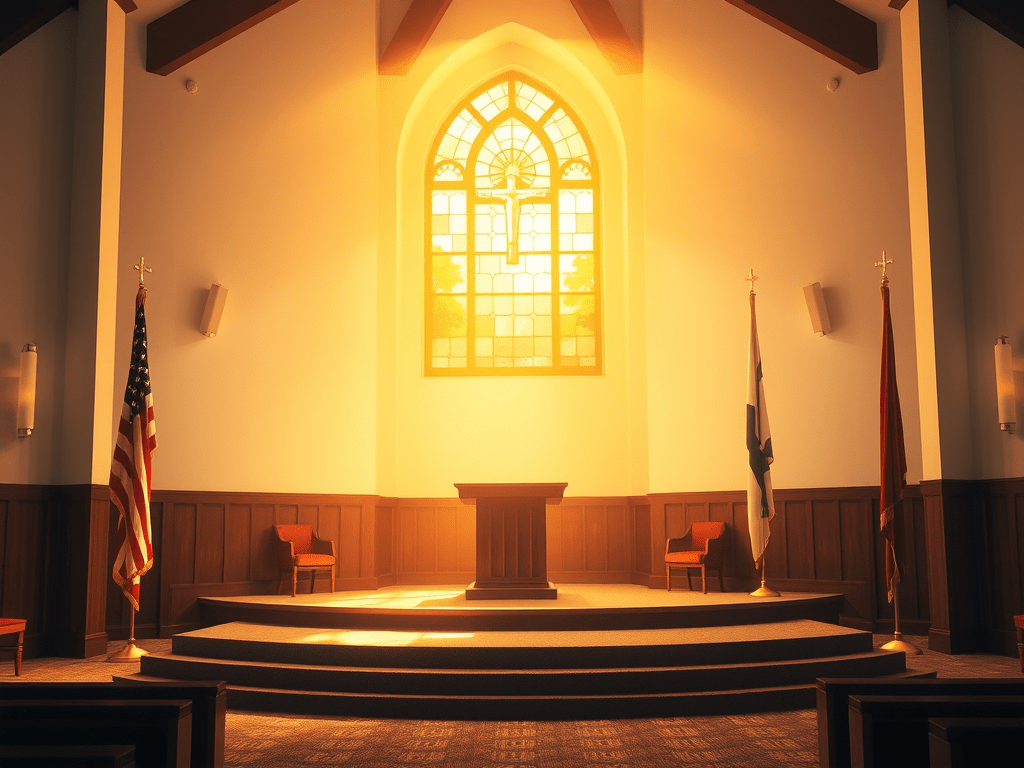
A Worship Pastor’s Journey Through Gospel-Centered Worship and Civic Expression
The Question That Won’t Go Away
I’ve led worship services that opened with the pledge and closed with “God Bless America.” I’ve also pastored in seasons where passionate members called for removing the flag from the sanctuary entirely. I’ve navigated between veterans who felt dishonored and pacifists who felt compromised. And through it all, I kept asking the same question: What does gospel-centered worship have to do with patriotic expression?
If you’re a pastor, worship leader, or thoughtful church member, you’ve probably wrestled with this too. Can we love our country and worship King Jesus without confusing the two? Is there a way to honor our earthly citizenship while proclaiming our heavenly citizenship? And how do we do this faithfully, whether we’re worshiping in suburban America, underground China, or post-Christian Europe?
The stakes are higher than mere preference or cultural accommodation. How we handle patriotism in worship reveals what we actually believe about the gospel, the church, and the kingdom of God.
What This Article Addresses (And What It Doesn’t)
Before we dive deeper, let me be clear about what we’re wrestling with here. This article focuses specifically on patriotic expressions within corporate worship services – things like displaying flags in the sanctuary, reciting the Pledge of Allegiance during worship, singing patriotic songs as part of our liturgy, and incorporating national holidays into our worship gatherings.
I’m not addressing the broader questions of patriotism in other contexts. There’s nothing inherently problematic about placing your hand over your heart at a civic ceremony, singing the national anthem at a ballpark, thanking veterans for their service, serving in elected office, or participating in community parades. These are separate conversations about civic engagement that deserve their own theological reflection.
My focus is narrower but no less important: When God’s people gather for corporate worship, what role should patriotic expression play? How do we honor our earthly citizenship without compromising our heavenly citizenship? How do we express appropriate gratitude for national blessings without falling into nationalist idolatry?
Here’s where we’re headed: We’ll start with what Scripture teaches about worship and citizenship, then trace how the church has navigated these tensions throughout history. We’ll examine how the gospel provides a framework for properly ordering our loyalties, and finally explore practical wisdom for worship leaders making real decisions about flags, pledges, and patriotic songs. Throughout, we’ll seek principles that apply to believers in every nation while respecting the diversity of local contexts and worship traditions.
Starting with Scripture: What Does Worship Actually Do?
Worship Forms Our Loves
Before we can ask whether patriotic elements belong in worship, we need to understand what worship is designed to accomplish. Scripture reveals that worship isn’t primarily about what we do for God, but about what God does in us. Through worship, the Spirit forms our affections, shapes our allegiances, and orients our hearts toward ultimate reality.
Paul captures this in Romans 12:1-2: “Present your bodies as a living sacrifice, holy and acceptable to God, which is your spiritual worship. Do not be conformed to this world, but be transformed by the renewal of your mind.” Worship is fundamentally about transformation – being renewed and reformed into Christ’s image.
As Augustine understood, we are fundamentally creatures of love – but our loves can be disordered. Jesus himself identified this as the heart of faithful living: “You shall love the Lord your God with all your heart and with all your soul and with all your mind. This is the great and first commandment. And a second is like it: You shall love your neighbor as yourself” (Matthew 22:37-39). Worship serves as heart training, teaching us to love the right things in the right order.
James K.A. Smith captures this perfectly: “We are what we love, and our love is shaped, primed, and pointed by liturgical practices that grab hold of our gut and aim our heart to certain ends.” This means everything we include in worship is formative. The songs we sing, the words we speak, the symbols we display – they all shape the hearts of God’s people. So when we consider patriotic elements in worship, we’re not asking a neutral question about cultural preference. We’re asking a deeply theological question: What kind of people is this forming us to be?
The Gospel Creates a New Citizenship
Paul’s letter to the Philippians gives us crucial insight here. When he tells this Roman colony that “our citizenship is in heaven, and from it we await a Savior, the Lord Jesus Christ” (Philippians 3:20), he’s not spiritualizing citizenship away from earthly realities. He’s establishing a hierarchy of loyalties that changes everything.
The word Paul uses – politeuma – was loaded with political meaning. Philippi was a Roman colony where retired soldiers lived as Roman citizens far from Rome. They maintained Roman customs, followed Roman law, and lived as outposts of Roman civilization. Paul says followers of Jesus are like that – but our city is heaven, our ultimate allegiance is to King Jesus, and we live as outposts of his kingdom.
This doesn’t negate earthly citizenship, but it subordinates it. Paul himself demonstrates this balance throughout Acts – he appeals to his Roman citizenship for protection (Acts 22:25-29) while maintaining that his ultimate identity comes from Christ. He tells the Romans to “be subject to the governing authorities, for there is no authority except from God, and those that exist have been instituted by God” (Romans 13:1), while also insisting that “we must obey God rather than men” when earthly and heavenly authorities conflict (Acts 5:29).
The gospel doesn’t destroy earthly loyalties – it properly orders them under the lordship of Christ.
Worship Proclaims Cosmic Lordship
Every worship service makes a claim about ultimate reality. When we gather to sing “Holy, Holy, Holy” (echoing Isaiah 6:3 and Revelation 4:8) or proclaim “Christ has died, Christ is risen, Christ will come again,” we’re announcing that Jesus is Lord over all creation. Not just Lord of our hearts, or Lord of the church, but Lord of presidents and prime ministers, kings and countries, empires and economies.
Paul declares this cosmic scope explicitly: “At the name of Jesus every knee should bow, in heaven and on earth and under the earth, and every tongue confess that Jesus Christ is Lord, to the glory of God the Father” (Philippians 2:10-11). This isn’t a future hope only – it’s a present reality that worship proclaims and anticipates.
This is why the early Christians got in trouble with Rome. It wasn’t because they refused to be good citizens – many were exemplary citizens. It was because they refused to treat Caesar as ultimate. They could honor Caesar, but they couldn’t worship Caesar. They could serve the empire, but they couldn’t give the empire their ultimate allegiance.
Revelation captures this perfectly in its vision of cosmic worship: “And I heard every creature in heaven and on earth and under the earth and in the sea, and all that is in them, saying, ‘To him who sits on the throne and to the Lamb be blessing and honor and glory and might forever and ever!'” (Revelation 5:13). Earthly kingdoms have their place, but that place is kneeling before the true King who bears the title “King of kings and Lord of lords” (Revelation 19:16).
Learning from Church History: The Patterns of Accommodation and Resistance
The Constantinian Shift: When Christianity Became Imperial
The conversion of Emperor Constantine in 312 AD changed everything for the church. What had been a persecuted minority suddenly became the religion of the empire. By 380 AD, under Theodosius, Christianity was the official faith of Rome.
This shift brought opportunities. Christian values influenced law and culture. Churches received imperial funding. The faith spread rapidly across the known world. But it also brought a dangerous temptation: to confuse the kingdom of God with earthly kingdoms.
Suddenly, Christian symbols adorned military banners. Bishops blessed imperial wars. The cross, once a symbol of suffering servanthood, became an emblem of power and conquest. Augustine developed just war theory partly to help Christians reconcile gospel peace with imperial military service.
This wasn’t all negative – Christian influence led to significant humanitarian advances. But it established a pattern that would echo through church history: the temptation to baptize earthly power rather than submit it to gospel authority.
Medieval Synthesis: The Dream of Christendom
Medieval Christianity attempted to solve the tension by creating Christendom – a unified Christian civilization where church and state worked together under papal authority. This experiment reached its height under Pope Innocent III, who claimed authority over all earthly rulers.
The Crusades perfectly embody Christendom’s confusion. Wars of conquest were blessed as holy endeavors. Killing infidels became a path to salvation. The cross led armies into battle. What began as a faith proclaimed by a crucified Messiah became a religion that crucified others in his name.
Yet even in this period, voices of resistance emerged. Francis of Assisi’s radical discipleship challenged Christendom’s accommodation to power. Monastic movements preserved practices of simplicity and service that contrasted sharply with imperial Christianity.
Reformation Fragments: New Nations, New Confusions
The Protestant Reformation shattered medieval unity but created new forms of confusion between the gospel and the nation. Luther’s doctrine of the “two kingdoms” attempted to distinguish spiritual and temporal authority, but Lutheran state churches often struggled to maintain that distinction.
Calvin’s Geneva experiment tried to create a godly commonwealth governed by biblical law. The results were mixed – significant social reforms alongside religious coercion that violated gospel freedom. The Reformers rightly insisted that Christ’s lordship extends to all of life, but sometimes confused that lordship with Christian control of earthly institutions.
In England, Henry VIII’s break with Rome created a national church that explicitly merged religious and political authority. The Church of England became the church of English nationalism, with the monarch serving as both political head and supreme governor of the church.
Radical Reformation: The Anabaptist Alternative
The most thoroughgoing critique of Constantinian Christianity came from the Anabaptist movement. These “radical reformers” insisted that the church must be a voluntary community of committed disciples, separate from coercive state power.
Anabaptists like Conrad Grebel and Felix Manz argued that when the church merges with earthly kingdoms, it loses its prophetic voice and compromises its gospel witness. They practiced pacifism, simple living, and religious liberty – often unto death. Their martyrdom testified to the cost of maintaining gospel integrity in the face of earthly pressure.
While Anabaptist separationism sometimes led to unhealthy withdrawal from civic responsibility, their witness preserved an important truth: the church’s primary calling is to be the church, not to run the world.
Cromwell’s Commonwealth: Puritan Theocracy
Oliver Cromwell’s Puritan Commonwealth (1649-1660) represented another attempt to create a godly nation through political power. Rejecting Anglican ceremonialism and episcopal authority, the Puritans sought to govern England according to biblical law.
The Commonwealth achieved some genuine reforms – expanded religious tolerance for Protestants, moral legislation, and educational advancement. But it also demonstrated the dangers of confusing gospel transformation with political coercion. The regime’s collapse and the Anglican restoration that followed deepened English suspicion of religious enthusiasm in politics.
Pietism’s Retreat and Fundamentalism’s Culture Wars
The 17th-century Pietist movement responded to state church nominalism by emphasizing personal devotion over public engagement. While preserving evangelical spirituality, Pietism often abandoned the public square to secular forces.
American fundamentalism inherited this tendency toward withdrawal, but then swung toward aggressive political engagement in the late 20th century. The “moral majority” and Christian right movements sought to “reclaim America for Christ” through political activism, sometimes conflating conservative politics with gospel faithfulness.
Contemporary Dominionism: NAR and Seven Mountains
Perhaps nowhere is this confusion more evident today than in the New Apostolic Reformation (NAR) and Seven Mountains dominionism. Influenced heavily by the Christian Reconstructionist movement, founded by Rousas John Rushdoony and developed by figures such as Gary North and Douglas Wilson, these movements advocate for Christians to take control of seven key “mountains” of cultural influence: religion, family, education, government, media, arts and entertainment, and business.
Rushdoony’s postmillennial theology taught that the church must Christianize the world before Christ’s return, implementing biblical law (theonomy) through political and cultural conquest. While most NAR leaders don’t embrace full Reconstructionist theology, they’ve adopted its essential premise: Christians are called to dominate earthly institutions rather than serve within them.
This creates a fundamental confusion about the nature of Christ’s kingdom. Jesus told Pilate, “My kingdom is not of this world. If my kingdom were of this world, my servants would have been fighting” (John 18:36). The NAR/Seven Mountains approach essentially says Christ’s kingdom is of this world and his servants should be fighting – just using political and cultural power instead of literal swords.
The worship implications are significant. When churches embrace dominionist theology, patriotic expressions easily become triumphalist declarations of Christian cultural supremacy rather than humble expressions of gratitude and civic responsibility.
Both extremes – Pietist withdrawal and dominionist culture war – miss the biblical balance of engaged discipleship that honors Christ’s lordship while respecting the God ordained jurisdictions of church and state.
The Gospel Solution: Christ as King of All
Jesus and the Politics of the Kingdom
Jesus’ ministry was intrinsically political – not in the sense of partisan politics, but in the deeper sense of challenging all earthly claims to ultimate authority. When he proclaimed the kingdom of God, he was offering personal salvation and announcing the arrival of God’s rule over all creation.
The temptation narratives in Matthew 4 perfectly capture this political dimension. Satan offers Jesus “all the kingdoms of the world and their glory” if he will “fall down and worship me” (Matthew 4:8-9). Jesus’ refusal – “You shall worship the Lord your God and him only shall you serve” (Matthew 4:10) – establishes a fundamental principle: earthly kingdoms have their place, but they cannot command ultimate allegiance.
This theme runs throughout Jesus’ ministry. He heals on the Sabbath, challenging religious authority. He cleanses the temple, confronting economic exploitation. He forgives sins, claiming divine prerogative. And he does all of this while teaching his followers to “render to Caesar the things that are Caesar’s, and to God the things that are God’s” (Matthew 22:21).
That famous saying isn’t about separating sacred and secular spheres. It’s about properly ordering our loyalties under God’s supreme authority. Caesar has legitimate claims, but those claims are limited by God’s prior and ultimate claim over all creation – including Caesar himself. As Daniel proclaimed to Nebuchadnezzar: “The Most High rules the kingdom of men and gives it to whom he will” (Daniel 4:17).
The Cross: Where Kingdoms Collide
The crucifixion represents the ultimate collision between earthly and heavenly kingdoms. Here we see what happens when gospel truth encounters political power. Pilate asks Jesus, “Are you the King of the Jews?” (John 18:33). Jesus responds, “My kingdom is not of this world” (John 18:36).
But notice what Jesus doesn’t say. He doesn’t say his kingdom has nothing to do with this world. He says it’s not “of” this world – not derived from earthly power structures or maintained by earthly methods. His kingdom comes from above and operates by different principles: the last are first, enemies are loved, strength is perfected in weakness.
The cross reveals both the limitations of earthly power and the ultimate victory of God’s love. Rome could crucify the Son of God, but it couldn’t stop the resurrection. Empire could silence the King for three days, but it couldn’t prevent his eternal reign.
This is why the cross became the church’s primary symbol rather than an imperial eagle or national flag. The cross announces that God’s kingdom advances through sacrificial love, not coercive power. It judges all earthly kingdoms while offering the possibility of redemption.
Pentecost and the Universal Church
The Day of Pentecost creates something unprecedented in human history: the body of Christ united not by ethnicity, geography, or political allegiance, but by the Spirit of God. When people “from every nation under heaven” hear the apostles “telling the mighty works of God” in their own languages (Acts 2:5, 11), it prefigures the church’s universal mission.
This doesn’t eliminate earthly citizenship, but it relativizes it. Christians remain Americans, Nigerians, Koreans, and Brazilians, but their primary identity comes from their membership in God’s family. They can appreciate their earthly cultures while maintaining ultimate loyalty to Christ.
Paul captures this beautifully in Galatians 3:28: “There is neither Jew nor Greek, there is neither slave nor free, there is no male and female, for you are all one in Christ Jesus.” Earthly distinctions remain, but they cannot divide the people of God. Our unity in Christ transcends every human boundary – including national boundaries.
Peter reinforces this identity as the body of Christ: “But you are a chosen race, a royal priesthood, a holy nation, a people for his own possession” (1 Peter 2:9). The church itself becomes a “holy nation” that transcends all earthly nations while calling believers to “honor everyone. Love the brotherhood. Fear God. Honor the emperor” (1 Peter 2:17).
This has profound implications for worship. When the church gathers, we’re not primarily gathering as Americans or Chinese or Germans. We’re gathering as the body of Christ, citizens of heaven who happen to live in various earthly locations. Our worship should reflect this heavenly citizenship while appropriately acknowledging our earthly contexts.
Practical Wisdom: Patriotism in Gospel-Centered Worship
The Formative Question: What Kind of People Are We Becoming?
After wrestling with these issues for over a decade, I’ve learned to ask one primary question when considering patriotic elements in worship: What kind of people is this forming us to be?
Every element of worship is formative. If we open our service with the Pledge of Allegiance, we’re teaching our people that American citizenship comes before heavenly citizenship – at least liturgically. If we sing “God Bless America” with the same enthusiasm we sing “Holy, Holy, Holy,” we’re suggesting that God’s blessing on our nation is as central to Christian faith as God’s holiness.
On the other hand, if we completely ignore our earthly context – never praying for our leaders, never acknowledging national tragedies, never expressing gratitude for earthly blessings – we risk forming people who think the gospel is irrelevant to ordinary life.
The question isn’t whether we should be patriotic or not. The question is how we express appropriate earthly loyalties in ways that serve rather than subvert gospel formation.
Biblical Guidelines for Practice
Scripture gives us several principles that can guide our decisions:
God’s Sovereignty Over Nations: The Bible consistently affirms God’s authority over all earthly governments. Daniel declared to Nebuchadnezzar, “The Most High rules the kingdom of men and gives it to whom he will and sets over it the lowliest of men” (Daniel 4:17). Paul reinforces this: “Let every person be subject to the governing authorities. For there is no authority except from God, and those that exist have been instituted by God” (Romans 13:1). This means we can acknowledge earthly authority while maintaining that all authority derives from God. When we pray for our leaders or express gratitude for our country’s blessings, we’re actually affirming God’s sovereignty, not national autonomy.
Proper Ordering of Loves: Augustine taught that sin fundamentally disorders our loves, causing us to love ultimate things as penultimate and penultimate things as ultimate. Jesus established the proper order: “You shall love the Lord your God with all your heart and with all your soul and with all your mind. This is the great and first commandment. And a second is like it: You shall love your neighbor as yourself” (Matthew 22:37-39). Worship should properly order our loves, teaching us to love God supremely while loving our neighbors (including fellow citizens) appropriately.
Prophetic Witness: The church must maintain the right to speak prophetically to earthly powers. Peter and the apostles established this principle when they declared, “We must obey God rather than men” (Acts 5:29). This requires a certain independence from political movements and parties. We can appreciate our country’s virtues while maintaining the freedom to critique its vices.
Universal Application: Whatever principles we develop must apply to Christians in every context. Paul’s instructions were written to believers under various governments – Roman imperial rule, local magistrates, and diverse cultural settings. A theology of worship that only works in American democracy isn’t biblical theology – it’s civil religion dressed in Christian language.
Liturgical Wisdom: How This Might Look
Based on these principles, here are some practical approaches I’ve found helpful:
Contextual Prayer Rather Than Rote Ritual: Instead of opening a service with the Pledge of Allegiance, we can regularly pray for our nation and leaders in ways that acknowledge God’s sovereignty. Paul commands this explicitly: “First of all, then, I urge that supplications, prayers, intercessions, and thanksgivings be made for all people, for kings and all who are in high positions, that we may lead a peaceful and quiet life, godly and dignified in every way” (1 Timothy 2:1-2). This expresses appropriate civic concern while maintaining proper theological order.
Occasional Rather Than Routine: Patriotic expressions work better as occasional responses to specific situations (national tragedies, Memorial Day, significant historical moments) rather than routine liturgical elements. This prevents nationalism from becoming habitual while allowing for appropriate civic recognition.
Thanksgiving Rather Than Triumphalism: We can express gratitude for our country’s blessings without suggesting that God favors our nation above others. Thanksgiving acknowledges God as the source of all good gifts while avoiding nationalist triumphalism.
Historical Honesty: When we do acknowledge our national heritage, we can include both celebration and lament – gratitude for genuine goods and repentance for sins. This models the biblical pattern of corporate confession and thanksgiving.
The Flag in the Sanctuary: A Case Study
The question of displaying national flags in worship spaces perfectly illustrates these tensions. I’ve seen churches wrestle over this issue, with passionate arguments on all sides.
Those who favor flag display often argue that it expresses appropriate gratitude for religious freedom and honors those who sacrificed to preserve it. They point out that Paul honored his Roman citizenship and commanded respect for governing authorities.
Those who oppose flag display worry about confusing earthly and heavenly kingdoms, especially when the flag shares sacred space with the cross. They argue that the church’s identity should be visually represented in our worship spaces.
I’ve come to believe this issue is less about the flag itself and more about what the flag represents in our particular context. In some nations and communities, flag display genuinely expresses thanksgiving for religious liberty and honor for sacrificial service. In others, it represents nationalist ideology that competes with gospel truth.
The key is ensuring that any patriotic symbol serves rather than subverts gospel formation. If displaying a flag helps our people grow in gratitude and civic responsibility while maintaining ultimate loyalty to Christ, it serves a good purpose. If it causes them to confuse earthly and heavenly citizenship or suggests that God blesses our nation above others, it becomes problematic.
Universal Principles, Contextual Applications
The beauty of biblical theology is that its principles apply universally while allowing for contextual variation. A house church in China faces different challenges than a suburban American congregation, but both can apply the same gospel principles.
In Persecuted Settings: Christians under hostile governments may need to express earthly loyalty very carefully, sometimes using coded language or symbolic actions. But they can still pray for their leaders and express appropriate civic responsibility while maintaining ultimate allegiance to Christ.
In Pluralistic Democracies: Christians in diverse societies can engage more openly in patriotic expression while being careful not to suggest that Christianity and nationalism are identical. Their challenge is maintaining prophetic independence while exercising civic responsibility.
In Post-Christian Contexts: Christians in formerly Christian societies must resist nostalgia for Christendom while preserving beneficial Christian influences on culture. They can appreciate their heritage while avoiding the temptation to restore past arrangements that compromised gospel integrity.
In Majority Christian Countries: Christians in societies where their faith is culturally dominant face the greatest temptation to confuse gospel and nation. They must work especially hard to maintain the distinction between Christian citizenship and national identity.
In every context, the same principle applies: We can love our earthly countries without making them ultimate. We can express appropriate patriotism without compromising gospel integrity. We can honor earthly authority while maintaining heavenly citizenship.
How Shall We Then Worship?
The Goal: Christ-Formed People
After all the theological reflection and historical analysis, our goal remains beautifully simple: worship that forms people into the image of Christ. This means creating liturgical experiences that properly order our loves, correctly orient our allegiances, and authentically express our identity as citizens of heaven living faithfully on earth.
Patriotic elements can serve this goal when they help us grow in gratitude, civic responsibility, and proper understanding of earthly authority. They subvert this goal when they confuse ultimate and penultimate loyalties or suggest that God’s blessing depends on national identity rather than gospel grace.
Pastoral Sensitivity in Divided Communities
Most of our congregations include people with very different views on patriotism and politics. Military families sit next to pacifists. Political conservatives worship alongside progressives. Recent immigrants share pews with multi-generational Americans.
This diversity isn’t a problem to be solved but a gift to be stewarded. It reflects the church’s character as the body of Christ and provides opportunities to model gospel unity across earthly divisions. Our worship should acknowledge this diversity while maintaining focus on our shared identity in Christ.
This requires pastoral wisdom that goes beyond simple rules. Sometimes it means explaining why we’re doing what we’re doing. Sometimes it means varying our practices to honor different perspectives within our community. It always means prioritizing gospel formation over cultural accommodation.
Gospel Rhythms Over Political Calendars
One practical approach I’ve found helpful is organizing our worship around gospel themes and biblical priorities rather than the political calendar. This helps maintain proper priorities while creating space for appropriate civic observances.
For churches that follow the traditional Christian calendar, this might mean focusing on Christ’s coming kingdom during Advent rather than year-end political analysis, examining our hearts for disordered loves (including nationalist idolatries) during Lent, and celebrating Christ’s victory over all earthly powers during Easter.
For free church traditions that don’t follow liturgical seasons, this could mean organizing worship themes around biblical books, doctrinal emphases, or gospel-centered series that keep Christ at the center while addressing contemporary issues. The key is ensuring that our worship flows from biblical priorities rather than cultural or political pressures.
Within this framework – whether liturgical or free church – we can observe civic holidays in ways that serve gospel formation. Memorial Day becomes an opportunity to reflect on sacrificial love – both human and divine. Independence Day becomes a chance to consider true freedom – both political and spiritual. Veterans Day becomes a moment to honor service while proclaiming Christ as the ultimate servant-king.
The goal isn’t to ignore our earthly context but to interpret it through the lens of the gospel rather than allowing it to set the worship agenda.
Teaching Through Worship
Every worship service is a teaching opportunity. Through songs, prayers, Scripture readings, and sermon applications, we can help our people develop biblical frameworks for understanding patriotism and citizenship.
This doesn’t mean turning worship into a political science class, but it does mean being intentional about formation. When we sing about God’s sovereignty, we can help people understand what that means for earthly governments. When we pray for our leaders, we can model how to honor authority while maintaining prophetic independence. When we celebrate communion, we can emphasize our identity as citizens of God’s kingdom.
The goal is to create theologically literate disciples who can navigate political engagement with gospel wisdom. This serves them far better than simply telling them what to think about specific political issues.
Conclusion: Worshiping the King of Kings
What I have learned over the years is that these tensions won’t be resolved through better policies or clearer guidelines. They’ll only be resolved through deeper gospel understanding and more faithful worship.
The question isn’t whether we should love our countries. Of course we should – God calls us to love our neighbors, including our fellow citizens. The question is whether we love our countries as ultimate or penultimate goods, as sources of identity or contexts for service, as objects of worship or occasions for gratitude.
When we gather for worship, we’re not primarily assembling as Americans or Chinese or Nigerians. We’re gathering as citizens of heaven who happen to live in various earthly locations. Our worship should reflect this heavenly citizenship while appropriately acknowledging our earthly contexts.
The cross and the flag can coexist in Christian worship, but only when their relationship is properly understood. The flag represents legitimate earthly authority deserving respect and gratitude. The cross represents ultimate divine authority demanding complete allegiance. Confusion between these symbols creates idolatry. Proper ordering of these symbols creates faithful discipleship.
This isn’t ultimately about flags or pledges or anthems. It’s about the fundamental question that every worship service either answers or avoids: Who is really Lord? If Jesus is truly King of kings and Lord of lords, then all earthly authorities – including our beloved countries – must bow before his throne.
That truth doesn’t diminish appropriate patriotism. It perfects it. When we love our countries as gifts from God rather than objects of worship, we’re freed to serve them more faithfully. When we honor our earthly citizenship while maintaining heavenly identity, we become better citizens of both kingdoms.
And when our worship properly proclaims Christ’s lordship over all creation, we form people who can navigate political engagement with gospel wisdom, serve earthly neighbors with divine love, and live as faithful citizens of heaven while blessing their earthly homes.
That’s the kind of worship our divided world desperately needs. Not worship that baptizes political preferences, but worship that proclaims the Lordship of Christ over all creation – including every nation, every government, and every competing claim to ultimate authority.
In the end, the flag will fade and the nations will pass away. But the kingdom of our Lord and of his Christ will endure forever. That’s the hope we proclaim when we gather for worship. That’s the vision that should shape every decision we make about patriotism in our services. And that’s the truth that can unite God’s people across every earthly division – including the ones that sometimes divide our congregations on Sunday morning.
Perhaps Samuel John Stone captured it best in his great hymn of 1866, written during a time when the church itself was wrestling with division and competing loyalties:
The Church’s one foundation
Is Jesus Christ her Lord;
She is His new creation
By water and the Word.
From heaven He came and sought her
To be His holy bride;
With His own blood He bought her,
And for her life He died.
This is our foundation. This is our identity. This is the truth that transcends every flag, every nation, and every earthly allegiance. When we remember who we are and whose we are, we can navigate the tensions of patriotism in worship with gospel wisdom, honoring appropriate earthly loyalties while maintaining ultimate allegiance to the One who bought us with His blood and calls us His bride.
Having served in pastoral ministry for over a decade, I continue to wrestle with these questions in congregational worship leadership. This article reflects ongoing theological reflection rather than providing final answers, inviting continued conversation within Christian communities as they seek to worship faithfully in their specific contexts.
 Josh Cehulik