
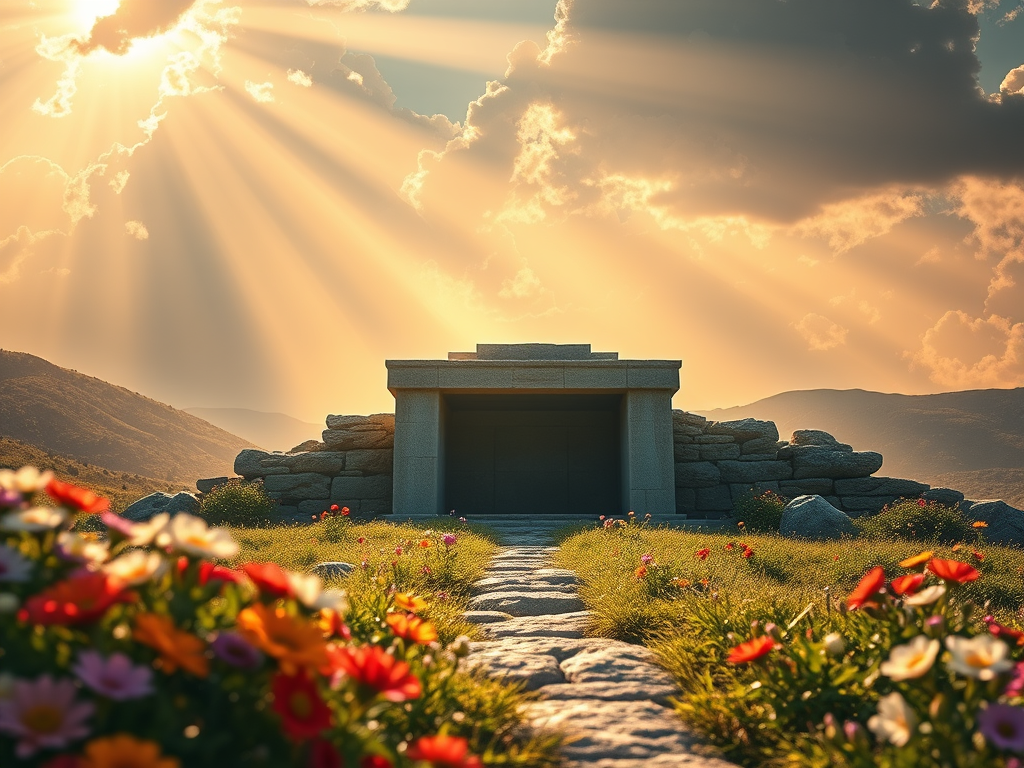
“But now is Christ risen from the dead, and become the firstfruits of them that slept.” – 1 Corinthians 15:20
We live in a culture obsessed with quick fixes and immediate solutions. Think about it: we want our coffee in seconds, our entertainment on demand, and our problems solved by the end of a 30-minute sitcom. But what if the deepest problems we face—death, meaninglessness, sin, and separation from God—can’t be solved by a quick fix or a motivational speech? What if they require something more radical, more supernatural, more glorious than anything we could engineer ourselves?
This is precisely where Resurrection Sunday enters our story. It’s not just a nice religious holiday or a seasonal tradition. It’s the explosive center of history where God’s decisive answer to our deepest problems burst forth from the tomb. The resurrection of Jesus Christ stands as the central claim of Christianity—without it, as Paul boldly admits, our faith would be futile, our preaching empty, and we would remain in our sins (1 Corinthians 15:14, 17). But with it? Everything changes.
The four passages we’ll explore today—Acts 10:34-43, Psalm 118:1-2 & 14-24, 1 Corinthians 15:19-26, and John 20:1-18—create a magnificent tapestry that displays the reality, significance, and power of Christ’s resurrection. Let’s dive in and allow these ancient words to awaken fresh wonder in our hearts today.
THE UNIVERSAL INVITATION (Acts 10:34-43)
Peter’s sermon in Cornelius’s house represents one of the most revolutionary moments in church history. Picture this: a Jewish apostle standing in a Gentile home, declaring that the God of Israel plays no favorites. This was scandalous! Peter himself needed a dramatic vision from heaven to get him through the door. Yet here he stands, proclaiming that anyone who fears God and does what is right is acceptable to Him.
The resurrection propels the gospel beyond every human barrier. Peter doesn’t just mention the resurrection—he anchors the entire Christian message in it: “Him God raised up the third day, and showed Him openly… to witnesses chosen before by God.” Notice the evidence-based nature of Christianity. This wasn’t spiritual philosophy or wishful thinking—it was witnessed history with flesh-and-blood implications.
What makes this passage so powerful for us today? It demolishes the idea that some people are “insiders” and others “outsiders” in God’s economy. The resurrection wasn’t just for the Jews, for the religious elite, or for those who had it all together. It creates a universal invitation that stretches across every racial, ethnic, and social boundary. The same power that raised Jesus from the dead is available to transform anyone who believes, regardless of their background or past sins.
THE CELEBRATION OF DELIVERANCE (Psalm 118:1-2, 14-24)
Written centuries before Christ, Psalm 118 pulsates with resurrection hope. The psalmist begins with thanksgiving for God’s enduring mercy—the Hebrew word hesed signifying God’s steadfast, covenant-keeping love that never fails. This alone would be enough reason for worship, but the psalm builds toward an astonishing proclamation: “I shall not die, but live, and declare the works of the LORD” (v.17).
Consider the defiant joy in these words. Death itself is being challenged. The psalm reaches its crescendo with the image of a rejected stone becoming the cornerstone, an image Jesus and the apostles would later apply directly to Christ’s rejection and exaltation (Matthew 21:42; Acts 4:11; 1 Peter 2:7). When the psalmist declares “This is the day which the LORD hath made; we will rejoice and be glad in it” (v.24), he’s not advocating general positivity—he’s celebrating a divine reversal, a deliverance so dramatic that it could only be attributed to God’s supernatural work of redemption.
What’s remarkable is how this ancient psalm anticipates Easter. The gates of righteousness, the rejected stone, and the declaration of new life all find their ultimate fulfillment in Christ’s resurrection. This isn’t coincidental—it’s God’s sovereign plan unfolding through human history. The same God who delivered the psalmist is the God who raised Jesus from the dead and who continues to deliver us today.
THE COSMIC VICTORY (1 Corinthians 15:19-26)
Paul’s treatment of the resurrection in 1 Corinthians 15 stands as one of the most powerful and illuminating theological reflections in Scripture. He begins with brutal honesty: “If in this life only we have hope in Christ, we are of all men most miserable.” Let that sink in. Paul acknowledges that if the resurrection isn’t real, Christianity isn’t just slightly mistaken—it’s pitiable. He stakes everything on this historical reality.
But then comes the triumphant declaration: “But now is Christ risen from the dead!” Paul sees Christ’s resurrection not as an isolated miracle, but as the beginning of a cosmic restoration orchestrated by God’s sovereign power. Just as death entered through one man (Adam), resurrection life comes through another (Christ). The resurrection isn’t just about Jesus—it’s about the entire human race and creation itself.
Paul then unveils God’s ultimate program: Christ will reign until every enemy is conquered, with death itself as the final foe to be destroyed. This is resurrection thinking on a cosmic scale! The power that raised Jesus from the dead is progressively subduing everything opposed to God’s good purposes. We’re not just celebrating a past event—we’re participating in an ongoing victory march toward the complete restoration of all things.
THE PERSONAL ENCOUNTER (John 20:1-18)
John’s account brings us to the intimate, personal dimension of the resurrection. Mary Magdalene arrives at the tomb while it’s still dark—a detail that captures both the literal pre-dawn hour and the spiritual darkness of grief. Finding the stone removed, she assumes the worst: someone has stolen Jesus’ body, adding insult to her already devastating loss.
After Peter and John investigate and leave, Mary remains, weeping outside the tomb. It’s in this moment of raw grief that the risen Christ approaches her—yet astonishingly, she doesn’t recognize him. Only when Jesus speaks her name—”Mary”—do her eyes open to the glorious reality before her. This personal encounter transforms her from a grieving disciple into the first resurrection witness, commissioned by Jesus himself to tell the others.
What strikes me about this narrative is its intimacy. The global, cosmic implications of the resurrection begin with a personal encounter in a garden. The same Jesus who defeated death knows Mary by name—and he knows yours too. Resurrection Sunday isn’t complete until we move from theological affirmation to personal encounter, from believing facts about Jesus to meeting him face to face.
CONCLUSION: THE RESURRECTION THAT CHANGES EVERYTHING
These four passages converge to give us a multi-dimensional view of Easter. Acts shows us the universal scope of resurrection power, Psalm 118 celebrates the divine reversal it represents, 1 Corinthians unveils its cosmic significance, and John invites us into personal encounter with the risen Christ. Together, they form an unshakable foundation for resurrection faith.
Here’s the stunning reality: the same power that raised Jesus from the dead is available to you today. It’s not a sentimental notion or a spiritual metaphor—it’s the transforming power of God that can break the hold of sin, heal the deepest wounds, and bring life to the deadest areas of your existence. The resurrection isn’t just something we believe happened—it’s something we experience as God’s power flows into our lives.
As we worship on Resurrection Sunday, we’re not merely commemorating an ancient event. We’re celebrating the living reality of Christ’s victory over death, a victory that continues to unfold in our lives and in our world. The tomb is still empty. The stone is still rolled away. And Jesus is still alive, inviting us to experience the resurrection power that changes everything.
POINTS TO PONDER
- Universal Hope: How does the truth that “God is no respecter of persons” (Acts 10:34) challenge your assumptions about who “deserves” God’s grace? Who in your life needs to hear this inclusive message of resurrection hope?
- Rejected Stones: Where in your life have you experienced rejection or failure that God might be working to transform into something beautiful? How does the image of the rejected stone becoming the cornerstone speak to your situation?
- Resurrection Order: Paul describes a specific order to the resurrection: “Christ the firstfruits, afterward those who are Christ’s at His coming” (1 Cor 15:23). How does the certainty of your future resurrection impact how you view your current struggles and mortality?
- Personal Recognition: Mary only recognized Jesus when he spoke her name. What keeps you from recognizing Christ’s presence in your daily life? How might you become more attentive to his voice speaking your name?
- Living Witness: Mary’s first response to encountering the risen Jesus was to tell others. Who needs to hear your testimony about how you’ve experienced resurrection power in your life?
CLOSING PRAYER
Lord Jesus, we stand in awe of your resurrection power. What seemed impossible—victory over death itself—you accomplished in three days. We confess that we often live as practical atheists, behaving as if the tomb were still sealed and death still reigned. Forgive us for our small thinking and our failure to grasp the magnitude of what you’ve done.
Today, we ask for resurrection power to flow into every dead area of our lives. Bring life to our relationships, our work, our ministries, and our deepest struggles. Let your victory become our victory. Help us to live as resurrection people—filled with unshakable hope, unconquerable joy, and unstoppable purpose.
May we, like Mary, hear you speak our names. May we, like Peter, proclaim your resurrection to everyone who will listen. May we, like Paul, understand the cosmic significance of Easter morning. And may we join the psalmist in declaring, “This is the day which the LORD hath made; we will rejoice and be glad in it.”
We pray this in the name of our risen Savior, Jesus Christ. Amen.
“The LORD is my strength and song, and is become my salvation. The voice of rejoicing and salvation is in the tabernacles of the righteous: the right hand of the LORD doeth valiantly.” – Psalm 118:14-15
 Josh Cehulik