
Do you remember learning about the horse latitudes in elementary school? I do. It’s stuck with me all these years because it painted such a vivid picture of a peculiar kind of danger – not the dramatic storms or treacherous rocks that usually spell disaster for sailors, but something quieter and perhaps more insidious.
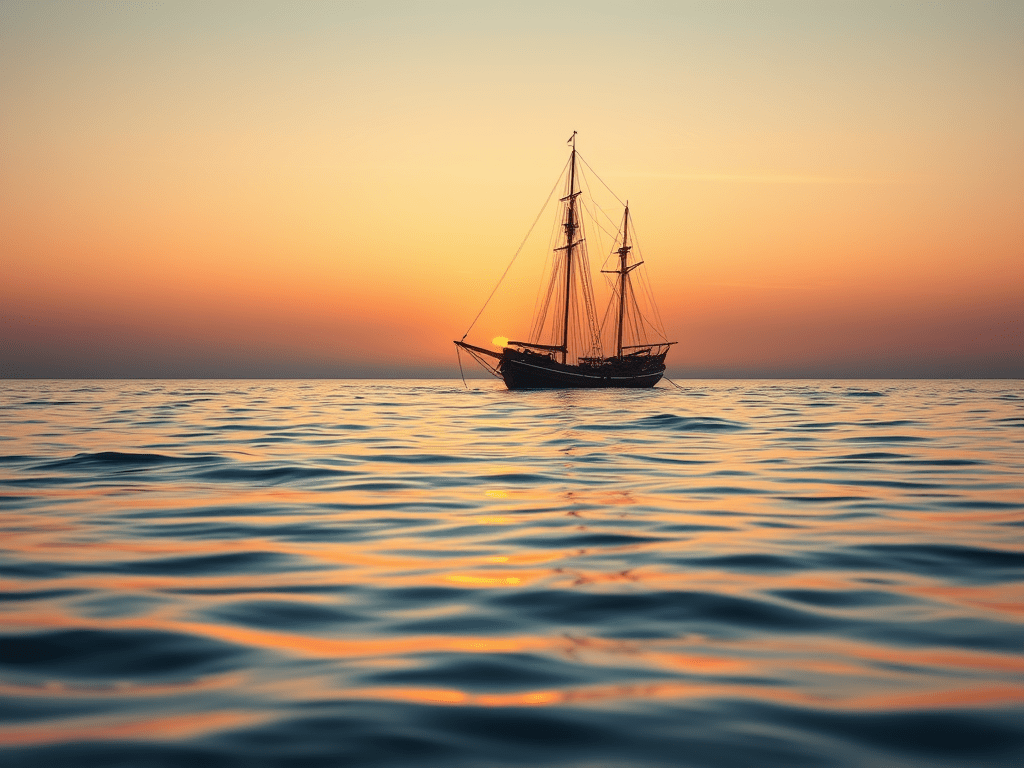
The horse latitudes are regions of the ocean where ships would often become trapped in eerily calm waters. No wind to fill their sails. No currents to carry them forward. Just… stillness. At first, it might have seemed peaceful, even welcome after challenging seas. But as days stretched into weeks, that peace would transform into something more sinister.
Ships would run out of fresh water, surrounded by an ocean they couldn’t drink from – an irony that feels almost biblical in its weight. Food stores would dwindle. Sailors, growing desperate, would sometimes throw their horses overboard to conserve water (hence the name), or worse, jump ship themselves. What started as calm became a crisis of survival.
As I’ve seen God work in my life over the years, I’ve realized that much of our spiritual journey takes place in these metaphorical horse latitudes. We talk often about praising God in the storm or celebrating on the mountaintop, but what about those long stretches where nothing seems to be happening at all? When prayers feel like they’re hitting a ceiling, when Scripture reading feels dry, when worship feels more like routine than revelation?
These spiritual doldrums can be just as dangerous as any storm. Like those ancient sailors, we might find ourselves tempted to abandon ship or throw overboard the very things we need for the journey.
The Gospel in Still Waters
The beauty of the gospel is that it speaks to us even – perhaps especially – in these moments. Remember that Jesus himself experienced the spiritual equivalent of the horse latitudes. In the garden of Gethsemane, he felt the profound silence of waiting. During his forty days in the wilderness, he knew what it was to persist when everything felt still and God seemed quiet.
The gospel reminds us that God’s work doesn’t always feel like work. Sanctification – that lifelong process of being shaped into Christ’s image – often happens in these seemingly stagnant moments. Like a plant putting down roots in still soil, sometimes the most important growth happens when everything appears motionless on the surface.
Navigating the Calm
So how do we worship in the horse latitudes? Here are some thoughts:
First, we need to recognize that stillness isn’t abandonment. The same God who calmed the storm can use the calm for His purposes. Sometimes, like Elijah in his drought, God provides in ways we don’t expect – ravens bringing bread, streams flowing in hidden places.
Second, we must resist the temptation to manufacture spiritual excitement. In the horse latitudes, sailors couldn’t create their own wind, and neither can we create genuine spiritual movement. Instead, we wait on the Wind of God’s Spirit, trusting His timing and His ways.
Third, we can use these times to develop spiritual disciplines that will serve us in all waters. Like sailors learning to conserve water and ration supplies, we can learn to find nourishment in small portions of Scripture, to pray even when we don’t feel like it, to worship even when the emotions aren’t overwhelming.
Pitfalls to Avoid
There are some common traps we should watch for in these seasons:
– Don’t mistake stillness for abandonment. God’s silence doesn’t equal His absence.
– Avoid the temptation to force dramatic spiritual experiences or manufacture emotional highs.
– Don’t compare your horse latitudes to someone else’s storm or mountaintop.
– Resist the urge to throw overboard the spiritual disciplines that seem dry but may be sustaining you more than you know.
Lessons from the Latitudes
These still waters have much to teach us:
1. Patience isn’t passive – it’s a form of active trust in God’s timing.
2. Sometimes the most profound spiritual growth happens in the quiet.
3. God’s provision often looks different than we expect.
4. Community matters – sailors didn’t face the doldrums alone, and neither should we.
A Final Thought
Perhaps the horse latitudes aren’t just a dangerous place to be avoided but a necessary part of our spiritual journey. Maybe these times of apparent stillness are actually God’s invitation to learn a different kind of worship – not the exuberant praise of the mountaintop or the desperate prayers of the storm, but the quiet trust that continues to show up, day after day, even when nothing seems to be happening.
After all, isn’t that what faith is? The confidence that even in the stillness, God is moving. The trust that even in the quiet, He is speaking. The certainty that even in the horse latitudes, He is leading us home.
So take heart, fellow traveler. If you find yourself in spiritual still waters, you’re not alone. Keep your eyes on the horizon, maintain your spiritual disciplines, and trust that the Wind of God’s Spirit hasn’t forgotten you. He who calms the storms can also stir the still waters – in His perfect time, in His perfect way.
 Josh Cehulik